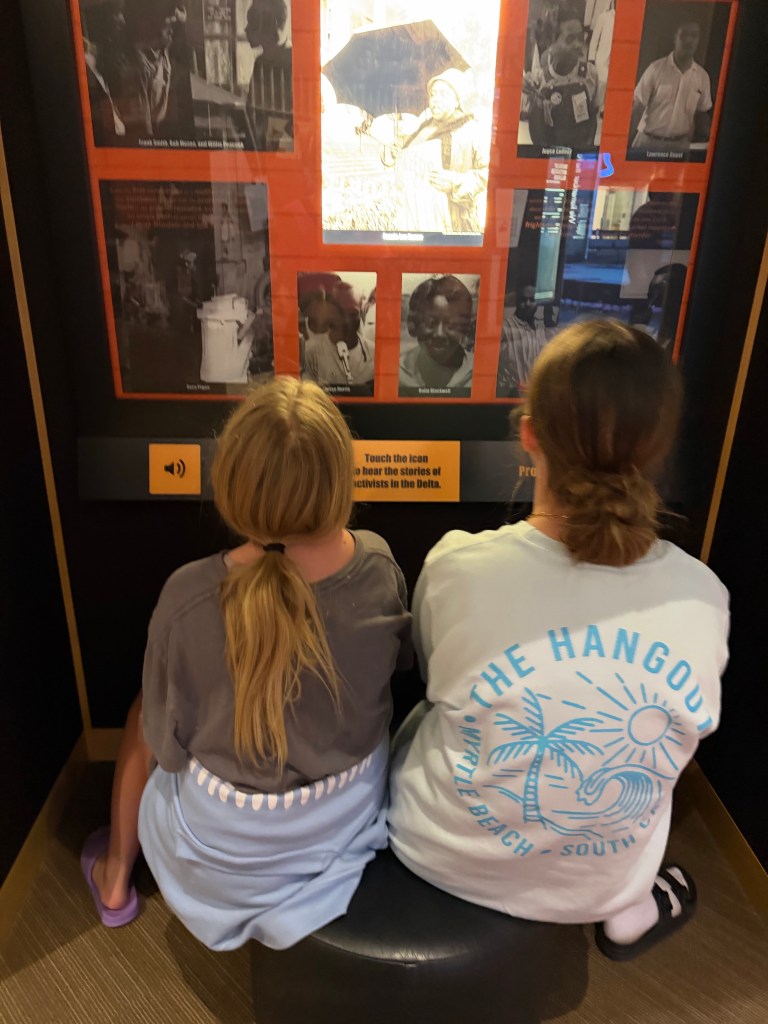
Today we visited the Mississippi Civil Rights Museum in Jackson with our children. Before we even walked inside I reflected on something I believe deeply, history isn’t meant to make us feel guilty, it’s meant to make us aware, aware of how people have suffered, aware of the courage it took to change things, and aware that every generation eventually faces the same question, will we be part of the problem or part of the solution? There is also a concern with being the one who sits and sees and never presents a plan of action to be part of the solution. These are the ones who are sometimes afraid to challenge group think. Many of the “Freedom Riders” lost their lives to help others so the risk is not lost on me but it is of great importance as well. Their risk gave way for a clearer pathway to be paved for the oppressed. Rarely is freedom free.
As we walked through the exhibits, there were several moments when I personally had to stop because the stories brought me to tears. The courage. The suffering. The injustice people endured simply because of who they were. It was much to process.
Many sections highlighted individuals known as “Points of Light,” ordinary people who chose courage when it would have been easier to stay quiet. These individuals were white and black, young and old, rich and poor. People like Medgar Evers, Fannie Lou Hamer, Vernon Dahmer, Amzie Moore, Aaron Henry, Victoria Gray Adams, Annie Devine, Unita Blackwell, and Lawrence Guyot, individuals who risked their lives so that future generations could experience greater freedom. Reading their stories made me wrestle with a difficult questions.
How does hatred grow so strong in someone’s heart that someone could participate in something like the Ku Klux Klan? History shows us that hatred rarely appears overnight. It is often fed slowly through fear, misinformation, isolation and the repeated message that certain people are somehow less human. When people are taught to dehumanize their neighbors and are never exposed to the beauty of cultures, lives and humanity, it becomes easier to justify unthinkable acts of violence on both sides. Some black people hated and feared all white peoples and some white people hated all black people.
I minored in sociology at Hardin-Simmons University. Sociology is the study of how societies influence the way people think, behave, and treat one another. One of the many things sociology helped me understand is that human thinking does not develop in isolation. Our ability to reason, question ideas, and feel empathy is shaped by the environments we grow up in. Environments can be healthy and allow hard questions to be asked and fear to be challenged. Unhealthily environments are afraid of losing control so exerting power is often a tactic used.
When communities are surrounded by poverty, violence, and limited access to education, survival often becomes the primary focus. In those environments people may be exposed to manipulation, propaganda, or rigid ideologies that discourage questioning and independent thought. Over time this can slowly weaken the development of empathy and critical thinking. When people are never exposed to different cultures, different ideas, or different kinds of neighbors, fear can grow where understanding might otherwise exist.
A friend of mine from Afghanistan once shared something that deeply shaped my perspective. I helped his family with a bicycle and his mom invited us over to have tea as a thank you. We walked into their home, took off our shoes and joined them around a table. She prepared hot tea, figs, cookies, chocolate and almonds. We were humbled. They had very little but shared everything just to thank us for the bicycles they would use as transportation. Humbled. We were so humbled.
My friend translated as his mom spoke. She and I shared some tears and I asked if I could give her a hug. She agreed. He told me his family is highly educated where they come from and they are also deeply grateful for the soldiers who rescued them when America left Afghanistan. His father and siblings tried but didn’t make it to the plane. They escaped hue to being hunted for helping American soldiers. They are very grateful for the opportunities they have found in America. He also explained how many of the extremists people from his country often grew up surrounded by violence, manipulation and very little education. Many of them were victims long before they ever harmed others and he agrees their ideologies can be very dangerous. That does not excuse violence, but it does help explain how extremism can take root. Extremism rarely grows where curiosity, education and exposure to diverse people thrive. It often grows where fear, isolation, and limited opportunity exist.
Education and relationships do something powerful. They challenge and expand the human mind and help people see the humanity in others. When people begin to see each other as human again, extremist thinking begins to lose its power.
I’ll also be honest about something personal. After the attacks on September 11, like many Americans, I felt fear when I heard the word Muslim due to my only exposure was Muslims bombing and hijacking our planes to terrorize us. That tragic moment shaped how many of us saw the world. Over time I realized I had formed opinions about an entire group of people I had never actually taken the time to know. So I started listening and learning as well as teaching. What I discovered is most people, regardless of religion, culture, or nationality, are simply trying to raise their children, live peacefully, and build a better future.
Faith itself is rarely the dangerous part. The danger is when belief systems are used to divide, control, or dehumanize others. Creating us versus them can be very dangerous for any people group. Walking through the civil rights museum reminded me that we are fighting more than one battle in our world. One battle is real, there are people who want to harm innocent lives and destabilize peace and extremism happens on every side. Another battle is happening quietly every day, the battle against bias, ignorance, and the temptation to judge entire groups of people instead of seeing individuals.
That is why the idea of being a “Point of Light” matters just as much today as it did during the Civil Rights movement. Being a Point of Light means choosing curiosity instead of assumption, choosing education instead of stereotypes, and choosing to see the humanity in people while still remaining wise and aware of real dangers. It also means paying attention to what fuels our communities, the media we consume, the conversations around our dinner tables and the messages we pass along to the next generation. Hatred grows when it is fed, but peace grows when people care enough to plant it.
Martin Luther King Jr. once said, “Darkness cannot drive out darkness; only light can do that. Hate cannot drive out hate; only love can do that.” Walking through that museum with my children reminded me that every generation gets its turn to decide what kind of neighbor it will be. My hope is that my children grow up understanding that when they see injustice, silence is not the goal. Becoming a Point of Light is. This takes intentional conversations. Faith, politics, and we the people can all be used to spread a message of support or harm. What role will you play in it all?
Personally I am still learning too, so if you see something differently, I am always open to thoughtful conversation, because understanding each other is how light spreads.
 Simply Encourage Blog
Leave a comment